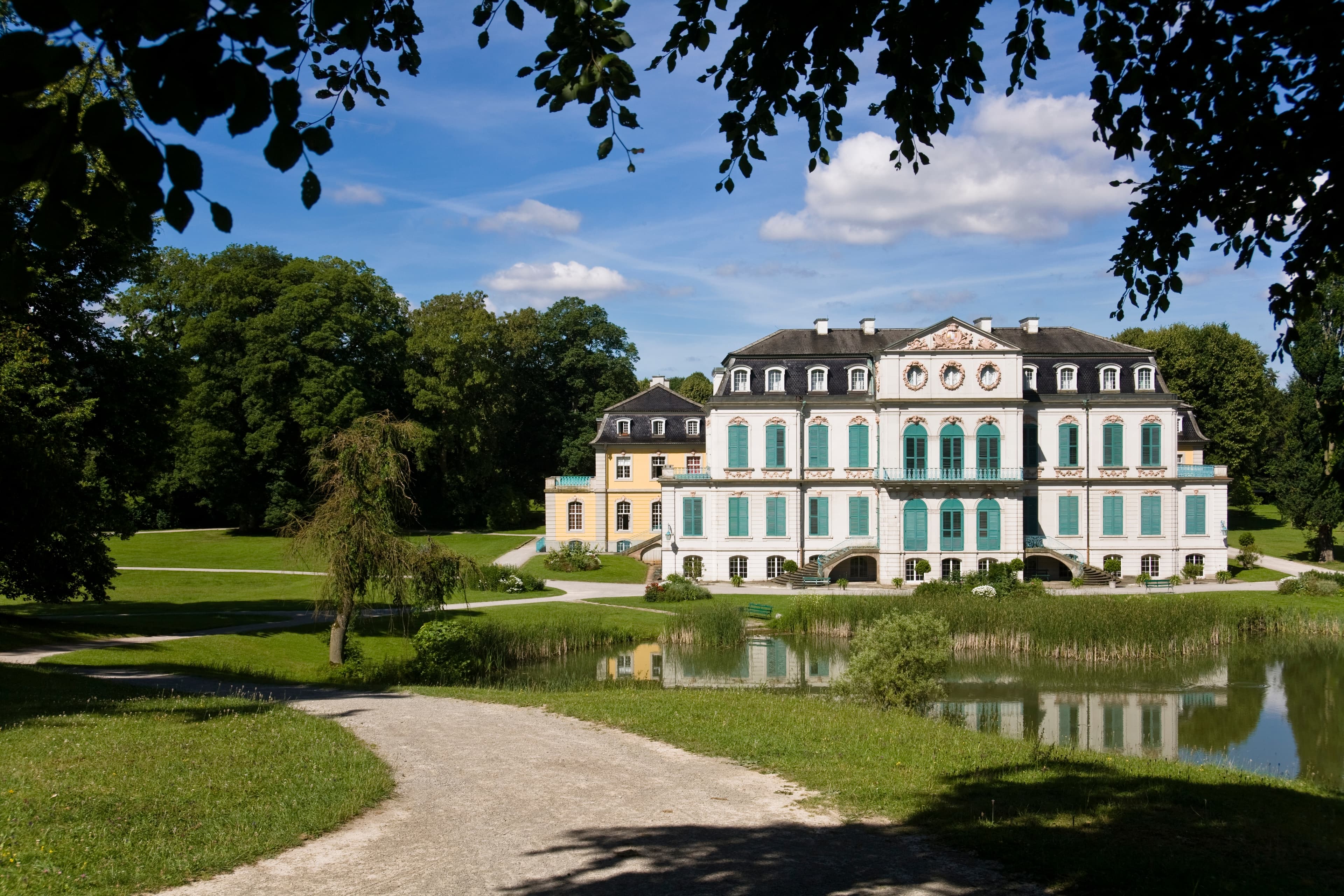
Conference in Kassel. Lecture hall at the Hessian State Museum
Monument preservation, museum form, and the question of authenticity. Castles and gardens in the self-conception of a changing society.
13. bis 14. November 2025
Within the research and conference series initiated by the Association of German Castle Administrations (AGDS) last year. State castles in the 20th century as a mirror of social and political change This year's conference is dedicated to the topic. "Monument preservation, museum form, and the question of authenticity. Castles and gardens in the self-conception of a changing society."
Call for Papers
Die Entwicklung der deutschen Denkmalpflege und ihrer Methoden spiegelt sich in derjenigen der Schlösser und Gärten. Bei den Schlössern, die nach dem Ende der deutschen Monarchie 1918 der Öffentlichkeit als Orte der Kunst und Geschichte offenstanden, reichte das Spektrum zunächst vom „Museumsschloss“ mit überlieferter Einrichtung bis hin zum „Schlossmuseum“, das als Hülle eine von Fachleuten neu konzipierte Ausstellung aufnahm. Vor diesem Hintergrund entbrannte schon in den 1920er Jahren zur Frage der unterschiedlichen Adaptionsformen überlieferter Schloss- und Garten-Ensembles ein Expertenstreit. In der Diskussion um die Frage, in welcher Form Bauten, Raumschalen und Gartenbereiche präsentiert werden sollen und inwieweit (Kunst)Historiker und (Kunst)Historikerinnen sie im Rahmen konservatorischer Kompetenz verändern dürfen, spielten Begriffe wie Authentizität, Aura oder das Verhältnis von Restaurierung, Rekonstruktion und materieller Originalität eine zentrale Rolle. Dahinter verbarg sich aber letztlich das Ringen um die Entscheidung, inwiefern ein Schloss die Lebenswelt der letzten Bewohner, ein stilgeschichtliches Idealbild, ein Kunstmuseum oder eher ein Lernort der Geschichte sein sollte.
Since this early time when castles became a new category of museums, the understanding of terms such as authenticity or reconstruction has changed with the societal and political conditions. Throughout the 20th century, events such as war-related destruction or temporary reuses also presented decision-makers with additional challenges and gave new impulses to the processes of appropriation.
The conference therefore dedicates itself to a special chapter in the history of monument preservation and museum development with its focus on castles and gardens and their time-bound solutions. The aim is to highlight to what extent certain tendencies and their backgrounds, as well as the (self)consciousness of a civil society that evaluated the cultural heritage of castles and gardens with standards differing from those of the aristocratic society, can be recognized in the "biographies" of facilities in Germany over the past hundred years.
Desired are presentations of maximum 30 minutes from the fields of art and cultural history, garden and monument preservation, and related disciplines. In addition to individual case studies, the question of overarching developments should also be addressed. Were there trends or guiding principles in the furnishing of castles or park design? Can different tendencies be identified in various regions or federal states? What influence did the respective political systems have? It would also be enlightening to look at the different conditions and evaluation criteria in the former Federal Republic of Germany and the GDR until 1990. How can the findings to be collected for Germany be evaluated on an international scale? And finally: How can the existing approaches to dealing with the cultural heritage of castles and gardens be further developed into the present and future of an increasingly diverse society?
Presentation applications with abstract (max. 500 characters) and CV are requested by 28.2.2025 to: Justus Lange justus.lange@heritage-kassel.deIn case of acceptance, travel and accommodation expenses will be covered.