%2F&w=3840&q=75)
“Otherness”—that is, the perception of differences between oneself and strangers—is an age-old human sensation. In contrast to this is “exoticism,” a more recent concept characterized by a fascination with certain countries, peoples, or civilizations. The otherness of the “exotic” caused unease, yet was simultaneously alluring and inspired wonder; in short, the “exotic” aroused curiosity among Europe’s rulers. In the 17th century, Asia, the Muslim East, Africa, Latin America, and Oceania were regions and cultures considered both mysterious and fascinating. This supposed “exoticism” fueled the stereotypes that shaped the image of the Other, thereby contributing to the construction of collective notions while also legitimizing colonial ideas. Yet it is by no means a derogatory or disparaging view of the foreign, but rather the attribution of positive values, the allure of difference, and the perception of an initial distance and its transcendence in the engagement with foreign cultures that harbor a hierarchical conception. The “we” as the bearers of civilization is set in opposition to the “other.” Regardless of which approach is chosen, it usually matters little what the “other”—the representative of the so-called “exotic”—thinks of this stigmatization. This dichotomy paved the way for a major colonial push on the part of European metropolises.
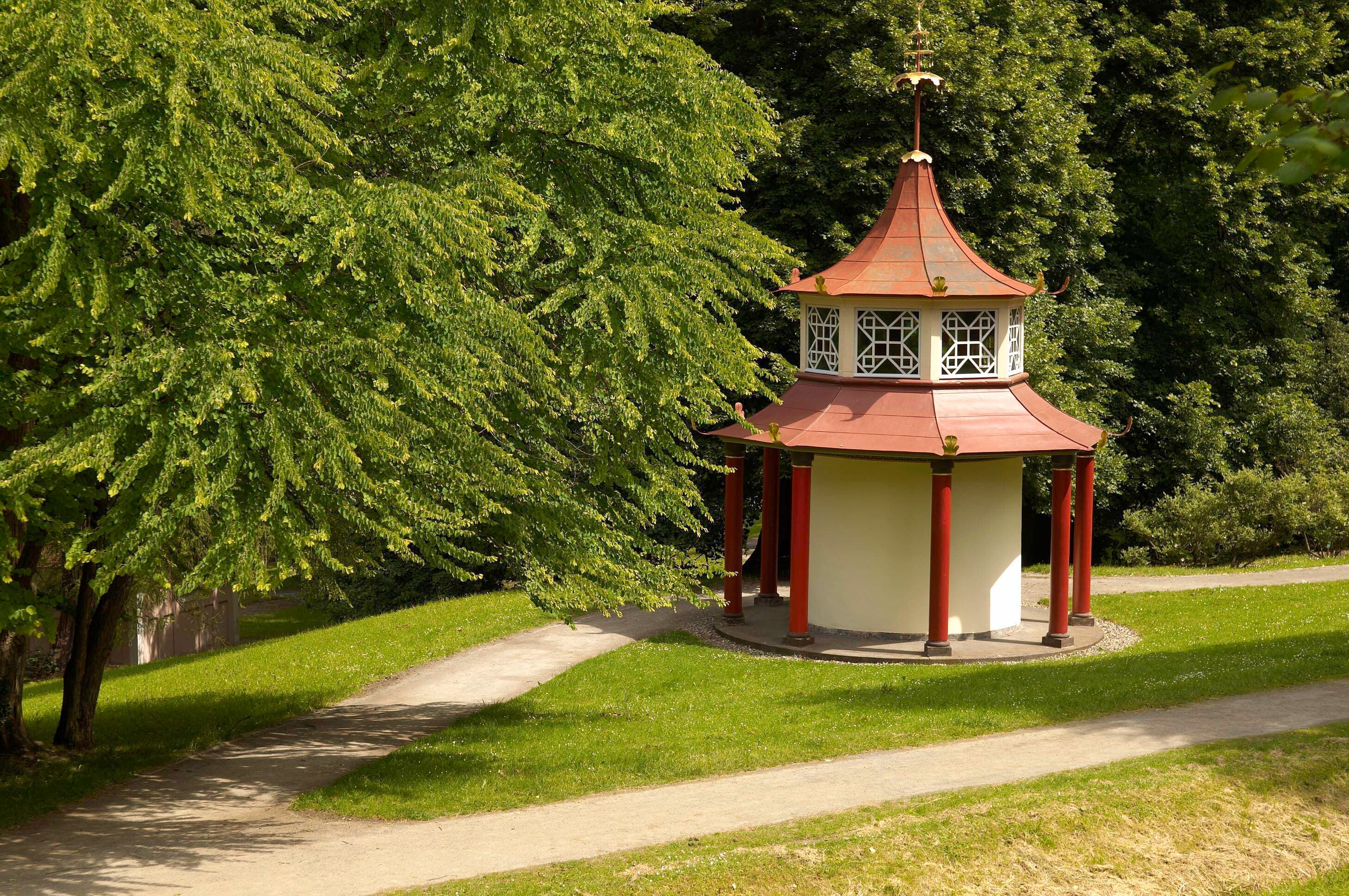
The creation of “foreign” architecture or the design of exotic gardens was part of the production of knowledge that reached its peak in the 18th century through the interplay of various political, social, and economic factors. Interest in the “foreign” formed the foundation. It ultimately linked the cabinets of curiosities that had emerged at the great European courts—including in Kassel—at the end of the 16th century with the exotic villages of the 18th century. The urge for curiosity, the fascination with the exotic, and the passion for ownership flourished throughout Europe in the early modern period, giving rise to phenomena such as zoological gardens or reconstructed exotic villages. The recourse to a restored, naive naturalness reflected the deep desire and fantasies of European rulers to return to a supposedly unspoiled nature. It testified to the longing to rediscover what had been lost in Europe and to seek an ideal state elsewhere. The staging of exotic flora and fauna was a sign of the rulers’ modernity, status, and cosmopolitanism, intended to impress their guests. Over time, however, this passion for the plant and animal world and the visual pleasure of the exotic gave rise to a new trend: incorporating people into this imaginary world and “exhibiting” them. These forms of exhibition were not uniform and varied according to the ruler’s inspiration and taste. Reconstructed villages, traveling troupes, circuses, and menageries began to flourish throughout the Western world, particularly in Switzerland, Great Britain, France, and Germany. Examples range from the Brazilian village in Rouen and the staged forty “Tupi Indians” for King Henry II and his wife in 1550, to the “personal black servants” and “chamber dwarfs” of Duke William V of Bavaria, to the exotic villages that emerged at numerous European courts in the 18th century. Landgrave Frederick II of Hesse-Kassel longed for the exotic and sought to establish a miniature world of other cultures with his “Chinese village,” but also to create a space for homogenization and encounter with the “Other.” Even though his intention was to pay homage to “foreign” cultures and his initiative represented a form of recognition of difference without devaluation, it entails a separation and an aspect of distancing that created an invisible yet tangible boundary between the “them” and the “us.” Even if the effect of this distancing mechanism in the village of Mulang is considered minimal—since the focus was on the architecture and symbols of the “Other” for the purpose of storytelling—the staging of Black workers reflected a hierarchical and ethnocentric logic.
Such stagings served not only to showcase the world’s diversity but also to shape and question notions of the “self” and the “other.” They revealed the tension between fascination, appropriation, and representation that characterized 18th-century European culture. Exotic villages were thus part of a trend in which the image of the “Other” was increasingly romanticized or portrayed in a distorted manner—a tendency that continued to influence colonial and racist interpretations in later centuries.
In the 18th century, many Black people lived and worked as servants in Kassel, as they had been brought there by officers from Hesse-Kassel during the American War of Independence or sent to Kassel. It is difficult to determine exactly how many Black people lived and worked in the Chinese village. However, it is documented that three Black women, Betty (e) Johnson, Hanne, and Catharina, worked at the dairy and the windmill and received compensation. Very little information is available about their working conditions, except that they were required to work in costumes to give the village an “exotic” charm and an “Oriental” flair. Despite a certain degree of social security, these Black people likely suffered from loneliness, feelings of inferiority, and oppression, as well as dietary adjustment issues, due to their “otherness.” Apart from the fact that the people living in the Chinese village served as objects of display to emphasize the exoticism of the site, it is suspected that some of them were later also included in scientific studies. Thus, a possible connection between the anatomical examinations conducted by Samuel Thomas Soemmering (1755–1830) and the village’s inhabitants is being discussed. According to reports by his biographer Rudolf Wagner, Soemmering conducted anatomical comparisons on the bodies of people of non-European origin to investigate differences from the European physique—a practice consistent with 18th-century anthropological research, though its motives and methods must be viewed critically from today’s perspective.
Regardless of where the line between established knowledge and conjecture lies, the depiction of “exotic” people during this period reveals a hierarchical mindset based not only on skin color but also on social status, origin, and societal affiliation. This form of objectification—whether motivated by colonial, social, or scientific factors—illustrates how strongly the contemporary perception of “foreignness” and “difference” was shaped by the power structures and knowledge systems of the time.
%2F&w=3840&q=75)
%2F&w=3840&q=75)
%2F&w=3840&q=75)
%2F&w=3840&q=75)
%2F&w=3840&q=75)